How often should I water my newly installed trees?
We generally supply a watering system with your installation if you are purchasing more than 10-trees at once. The root balls of the field grown trees should be fully saturated with water once per week from approximately May through October depending on your frost dates. The root balls of containerized trees should be fully saturated 2-3 times per week depending on the temperature and soil type during the growing season outlined above.
While our watering system is generally fool proof and is intended to be a “permanent” system, it must be closely monitored on watering days to ensure that the trees are receiving an adequate amount of water. Once the trees and watering system are in your possession, you are solely responsible for them. We are always here to help with additional questions or concerns.
What does the irrigation system include and how does it work?
The irrigation system includes one water time attached to a standard 3/4” hose bib. In addition to the timer, tubing and emitters are installed under the trees assuming the trees are in close proximity to one another (5’-8’). We do not supply a connection pipe or hose from the water source to the piping under the trees or from one area of trees to another. The optimal situation would be to have a stand pipe to supply the water on a separate zone. In most cases a standard garden hose completes the connection from the timer to the piping under the trees. We do not supply the connection hose - we only supply the timer, piping under the trees, and 2-gph emitters. The water supply stays on during the growing season (April - November) containerized trees are thoroughly watered twice per week and field grown trees are thoroughly watered once per week during dry conditions. If the trees are receiving sufficient water from rain events, the additional water may not be needed.
The provided timer cannot be exposed to freezing temperatures. We recommend turning water supply off and bringing timer indoors in early November and re-connecting late April. Refer to the first guidelines pertaining to your specific area for more accurate guidelines.
How fast does green giant arborvitae grow?
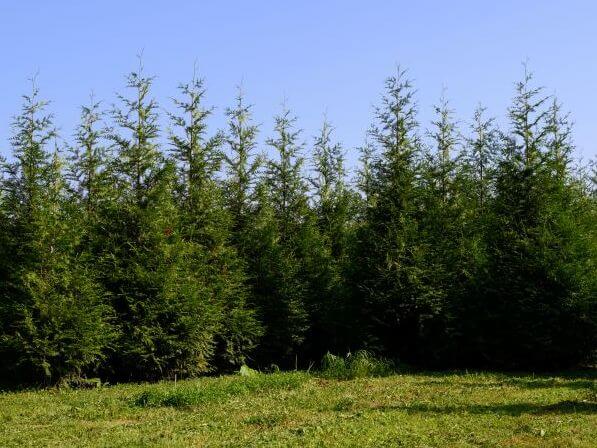
In the right conditions, Green Giants can grow 3 feet in a single growing season, even without fertilizer.
What's the Difference Between Thuja and Arborvitae?
Thuja Green Giant and Green Giant Arborvitae are different names for the same thing.
Is Thuja Plicata the same as Green Giant?
Not exactly. Green Giant's botanical name is thuja plicata x standishii, meaning that it is a hybrid of two thuja species: t. plicata (Western Red Cedar) and t. standishii (Japanese Arborvitae).
Do you have arborvitae seedlings?
Not yet. Most of our Green Giants are field-grown and spend a few seasons in the ground at our nursery to ensure that they are well rooted and ready to take off once delivered to you. We also offer container-grown trees in sizes up to 8 ft, but availability varies.
Do you sell arborvitae seeds?
No. Our Green Giants spend a few seasons in the ground at our nursery to ensure that they are well rooted and ready to take off once delivered to you.
When is the best time to prune green giant arborvitae?
The best time to prune Green Giant Arborvitae is in the late winter to early spring, just before new growth begins. This timing reduces the chance of the tree experiencing winter injury from pruning and allows the fresh cuts to heal cleanly with the onset of the growing season.
Are green Giants western red-cedar?
Green Giant Arborvitae is a cross between two species of thuja: Western Red Cedar - thuja plicata - and Japanese Arborvitae - thuja standishii. It is faster growing than either of its parent lineages and much more popular in landscape applications.
What type of soil does green giant arborvitae need?
Green Giants can survive and even thrive in a wide variety of soils and moisture conditions. The ideal type is loamy with lots of organic matter for high nutrition and good drainage. The biggest challenge for Green Giants is poorly drained soil like clay. If rain water pools for a long time after rain, consider amending soil or planting your trees in a raised ridge to keep roots above standing water.
Can Green Giants grow in acidic soil?
Yes. Green Giants can tolerate pH between 4.5 and 7.5.
Will you plant the trees for me?
We offer planting services within 30 miles of our nursery in Galena, MD. Outside of that, we happily offer shipping, but planting services will be up to the customer. We sometimes make exceptions for large orders.
How big does Green Giant Arborvitae get?
Green Giant Arborvitae is known for its rapid growth rate and can become quite tall when mature. Typically, a Green Giant Arborvitae can reach 50 to 60 feet tall and 12 to 20 feet wide at maturity. While it grows quickly, often 3 to 5 feet per year when young, final size depends on soil quality, available space, and overall care. If needed, it can be trimmed in early spring before new growth starts.
Can Green Giant Arborvitae grow in rocky soil?
Yes, but a mix of organic matter will help keep moisture in a preferable range.
.png)